
On Saturday morning, Donald Judd’s 100 Untitled Works in Mill Aluminum was glimmering in the Marfa sunshine, bathed in light with nobody to see it. It was hours before The Chinati Foundation opened, and I was wandering around the museum’s grounds—taking in what Roberta Smith called, in her obituary of Judd, “permanent installations of contemporary art that are among the largest and most beautiful in the world.” I had the whole thing to myself, until I heard a rustling.
It was Sir Nicholas Serota, the former director of the Tate who was knighted for his services in 1999. Like me, he was scurrying around, totally in awe.
He had arrived in far West Texas from London the day before.
It was fitting enough to see Sir Nick in Marfa at the start of October. For years, Chinati Weekend—the annual food-filled meeting of Chinati artists, board members, and local fans that doubles down on both the conceptual art and the live country music—was held smack-dab in the middle of Frieze London, making it near-impossible for a subset of the art world to attend both.
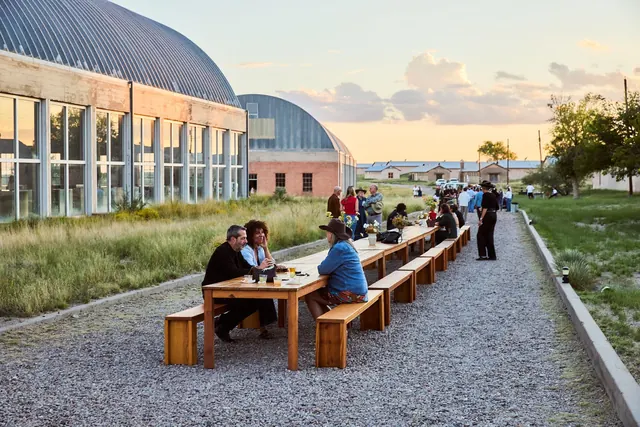
But this year, Chinati director Caitlin Murray swapped the dates, potentially opening the weekend up to those who must get to the art fairs in Europe. The benefit dinner held on the museum’s grounds Saturday night brought out everyone from the musicians whom I saw play at a saloon Thursday night to Charline von Heyl and Christopher Wool, two of the most celebrated Marfa artists.
Wool has a show up at the Brite Building in downtown Marfa until 2027, which is worth the trip all by itself.
When I start to describe this art world oasis to neophytes, or even those who know only that there’s something called Prada Marfa, I start by saying this: You know how art experiences that are hyped to enormous heights often don’t live up to expectations? Marfa’s the opposite. Whatever you’ve heard about the place, it’s better in real life—more extreme, more intense, more wacky, more beautiful.