The Californian once cultivated petri dishes breathed on by artists that turned ‘murky and scary’. But now, in our dystopian age of space technocrats, she’s taking inspiration from Nasa shots of asteroids
‘I had artists from all over the world breathe over petri dishes,” says Liz Larner. “It was a piece of international art made from breath bacteria.” The American sculptor is reminiscing about her 1988 work Every Artist Gave a Breath, a fragile and strangely evolving work of art grown on agar.
Exhibited in a 2022 show, it has since transformed in various ways: some bacteria has morphed into “beautiful, dried wafers in colour”, while other dishes “turned into a really weird blackish-green, really murky and a little scary”.
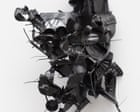
Larner is no stranger to making alluring work out of strange materials, from human hair and false eyelashes to leather and surgical gauze. For her first major exhibition in the UK – A Hard Line to Bend at Camden Arts Centre in London – the sculptor has been transforming single-use plastic into pieces that bristle with seductiveness and menace.
“I was living in LA at the time when China stopped accepting American plastic, which was where we were sending it all to be recycled,” she says. “I started taking it to my studio – it got so huge, I had to hang it from my ceiling.”
Assemblages such as Meerschaum Drift (2020-21) suggest a haunting analogue to our plastic-choked oceans. “I realised there’s so many smart people designing these objects made of plastic that are made to be discarded. We don’t even see them, all these different forms. We can’t see it. We just use it.”
Born to a California farming family in 1960, Larner recalls how the state “sprayed DDT [a toxic insecticide since banned] over our house for the first seven years of my life”. Engaging in recent years with eco-feminism (such as Rosi Braidotti’s 2019 book Posthuman Knowledge), she acknowledges her own ambiguous position.
“Maybe I’m implicated because I’m a sculptor. But I feel like we need to see these materials in different ways.
To try and imagine something different.”
In our dystopian age of SpaceX technocrats (“There are all these movies about disaster, except our lives are the biggest movie about disaster”), it’s not only Earth that’s being eyed as a commodity. Larner’s ceramic “asteroids”, such as 2022’s Nyx, transpose official Nasa photos into 3D forms, their glazed surfaces crenellated and mesmeric.
Yet for all her precision, Larner is as preoccupied with what’s not there as what can be captured. When it comes to colour, she paraphrases Wittgenstein: how do we know if two people are ever seeing the same shade of yellow?
“In sculpture, colour is usually subservient to form. And I want to make my work not to do that.
I want them to be together and to each have their interaction with each other.”
The show’s eponymous work was inspired by the Burney Relief, a Babylonian terracotta plaque said by some to depict the mythological Lilith. She fled the Garden of Eden (sometimes portrayed as a snake), refusing her fate as Adam’s wife.
“What I find interesting about her is that she’s not a fighter. She just says no.
And that’s powerful for everyone, not just women.” We’re speaking on the day that Gloria Steinem’s death is announced, and Larner namechecks the feminist pioneer – alongside Dolly Parton – as similarly trailblazing. “I find something ‘Lilith’ about them both.
They went their own way but with such style and grace. They took a different path.”
I ask Larner about her time studying at the California Institute of Arts with John Baldessari. “Art school could be tense, people having their positions.
But John let all that flow together,” she says. Later, she ran with LA’s 80s art crowd, where artists, poets and writers (including Dennis Cooper, Bob Flanagan and Mike Kelley) would gather at Beyond Baroque arts centre.
It’s far from today’s terminally online glare and the flattening grid of Instagram. “I was so lucky to grow up in that scene,” Larner says.
“We’re in such a different time now, where everything is seen before you experience it. There’s so much pre-knowledge.”
She herself never joined social media (“There’s only so much time in every day. You have to decide what you want it to be about”).
But despite refusing any easy categories for herself or her work, she still believes in the power of making objects to reshape reality. “That’s why I like sculpture.
You have to walk in there and move around, while you’re thinking and seeing. And maybe talk to somebody too.
Or watch somebody.” She smiles. “I wonder what they’re thinking by how they’re moving around.”