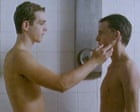
Everyone thinks Byker Grove broke the taboo in 1994, but another teen drama got there first. Here’s the astonishing story of Two of Us, which put a gay relationship on UK screens – and was the original Heartstopper
W hen I started looking for anything queer aimed at kids on TV from around the time I was born in 1989, I came across a children’s drama called Two of Us. Directed by Roger Tonge and written by Leslie Stewart, it was surprisingly akin to the 2020s series Heartstopper , both in its plot and in the way it makes you feel. But the reaction at the time couldn’t have been more different.
Both feature one character who realises he likes both boys and girls, who falls in love with another guy. Both are set at a comprehensive school. Both have characters who face homophobia and stigma but manage to find a way through because of their love and support for each other.
Yet while Heartstopper resulted in near-universal critical acclaim and received a string of awards, Two of Us was pulled from its planned BBC transmission and was not shown until the following year, 1988. It ended up being shown late at night, with the happy ending changed and a single kiss between the boys removed. The Sun ran an editorial saying that the film should be “returned where it belongs: the closet.”
“The real shock for me was that we were quite mild, really,” Stewart tells me now. “It was just a love story. I spoke to Roger. I said, the note we must keep, and that I’m keeping, is that it’s a love story, but it’s just two boys.”
He’s right. It is mild.
It is just a love story. I’ve seen it.
It could be filmed and shown today, albeit without some playground humour between Phil (Lee Whitlock) and his girlfriend Sharon (Jenny Jay). Only 60 minutes long, the film starts with Phil smitten with Sharon but pulling away whenever he is near his close friend Matthew (Jason Rush).
At a disco, Phil shares a slow dance with her but locks eyes with Matthew. I knew what was happening here; any queer viewer would.
Phil is clearly developing feelings for Matthew and doesn’t know what to do with them.
Later, he looks at Matthew’s physique for just a little too long while they shower together at a local pool. With just the two of them in the showers, Matthew faces Phil and places his hand first on his cheek, then on his shoulder.
He tells him, reassuringly, that everything is going to be OK. This hits me right in the stomach.
The first time I saw same-sex attraction depicted on television was deep into my teenage years, after I knew I was gay, the day before I came out. It was a confirmation rather than a realisation, long after a swirl of anxiety had started to play out in my head.
Deep down, I could sense why the film had been pulled, but I wanted to find out more. So I went to Seaford in Sussex, where the two boys eventually run off together in the film.
I bought some fish and chips and ate them on the seafront before going to see Roger Tonge. In his hallway, when I enter his house, there’s a framed front page of the tabloid Daily Express: “BBC ACCUSED OVER GAY TV FOR SCHOOLS” it says in a large font.
It’s his film.
Originally made to be shown in schools as part of the BBC’s Scene strand, aimed at teenagers, Two of Us was commissioned for the rare treat in class when the television came out on wheels. The standalone programmes were recorded by teachers for use in the classroom and also repeated in the early evening on the BBC, attracting millions of casual viewers.
Tonge’s hope was that the film would reduce stigma, change attitudes and provide hope for any tormented viewers. The creators knew it would receive some heat.
Matthew and Phil at that time were legally underage: until 1994 the age of consent was 21, before it was lowered to 18 (apart from Northern Ireland). Between two heterosexuals?
It was 16. “That was one of the driving facts of writing,” says Stewart.
“Twenty-one? Come on!”
Yet the events of 1986 and 1987 set a course that would change a generation of young queer people, myself included. The LGBTQ+ community was already in significant hardship from the hostility of the tabloid press and the suffering and associated stigma from the HIV/Aids crisis.
Now there was a new law on the horizon: Section 28. The commission and filming of Two of Us in 1986 coincided with that moral panic resulting in the law’s introduction.
Taking place the same time as the rise of the Moral Right, a belief in traditional family values and anti-homosexual sentiment, prime minister Margaret Thatcher capitalised on this panic and demonisation ahead of the 1987 general election. It was a vote winner. A British Social Attitude Survey at the time said that 64% of adults found sexual relations between two people of the same sex “always wrong”, up from 50% four years earlier.
The people who made Two of Us took precautions while filming. The crew were advised not to tell anyone what it was about.
Nervous bosses quizzed Tonge about how far the intimacy of certain scenes was going to go. “Where would the hands go when Matthew touches Phil?” Tonge was asked.
He wanted to give a physical re-creation. “The only thing to touch was a filing cabinet,” he tells me.
“So the filing cabinet became Phil, and I was Matthew, and I approached the filing cabinet and made sure that my hand stayed with the top drawer and didn’t go down.”
Two of Us was due to air in March 1987 but was pulled by the BBC before broadcast. In a statement, the BBC cited the heated political debate at the time meant “it would now be difficult for many teachers to use these programmes in the manner intended”.
Tonge and Stewart hoped that after the election the heat would subside and they could show the film, but Thatcher doubled down: “Children who need to be taught to respect traditional moral values are being taught that they have an inalienable right to be gay.” Inalienable right, as if we get to choose.
That September, stark new guidelines about what could and could not be taught about sex education were sent to all schools, paving the way for Section 28. There was a chance Two of Us could have been buried altogether, yet the new BBC Schools head, Alan Rogers, championed the film.
He believed that in order to get it screened, changes would need to be made. BBC bosses demanded dialogue cuts.
Tonge and Stewart accepted a more ambiguous ending. A kiss between Matthew and Phil in a tent together was also cut.
Two of Us was eventually shown on Friday 25 March 1988 at 11.30pm. The timing was suggested by lawyers so it wouldn’t be seen as a direct challenge to Section 28 and so teachers could record it and decide whether to show it to their pupils. The BBC continuity announcer warned that it contained “themes of a sensitive nature.”
In subsequent years, Tonge heard from then teenage viewers who had gone up to their rooms to secretly watch it without their parents knowing. I’m shown some letters forwarded to the Radio Times following its airing.
I cannot begin to tell you how they moved me. There’s one from a teacher counselling a 17-year-old who was gay and had attempted suicide.
Another from a viewer who declared themselves as being previously antagonistic and then wrote: “You have made one viewer a little less bigoted.” Nearly all of the calls received by the BBC that day were positive.
One letter stands out to me, deep in a numbered file: “Look, men of 45 don’t cry, especially about TV plays. So, I’m not crying, honestly.
I’ve just got a bit of grit in my eye [...] There are pains that won’t go away, even if you push them to the very back of your memory. You think your scars are healed, and then pow! – along comes something which re-opens the old wound, and it hurts like hell again. [...]
I watched Two of Us, and it was very painful. The fear, the hatred, the rejection, the uncomprehending ignorance it depicted rang true.
But equally true was the evidence of fear and rejection in the real-life BBC. A simple love story was delayed for many months while worthy men in suits debated whether it could be allowed to sully our screens.
Finally, it was given the go-ahead, around midnight, after a gentle kiss had been suppressed. Even at midnight, a kiss between two men is too dangerous for today’s prissy, repressive BBC.
This hurts me deeply. And it hurts me to realise that gay kids in our schools must still suffer as I did 30 years ago. Oh, in due course they will become hardened, as I did. They will push the pain to the back of their memories, until they believe that it no longer hurts. But the pain won’t go away.”
After reading this, I learned something staggering. Two of Us was sold to different markets around the world, but it had to feature the version the BBC aired – the ambiguous ending with the kiss removed.
Yet Tonge actually slipped them the original version with the happy ending and the kiss intact. The film also aired in full at LGBTQ+ festivals.
“That was all secret,” he tells me. “[The BBC] don’t check what is going on.” For a while, the only place you could not watch the original version was where it was made, in the UK.
“That must make it the most unusual programme in the history of TV,” Tonge adds.
Two of Us was eventually shown in the daytime in 1990. Another press storm ensued, including the Daily Express front page that now hangs in Tonge’s hall.
Yet again, without telling his bosses, Tonge managed to find a way to keep the ending ambiguous, but it featured the kiss in the tent. Two of Us had been stored in a special cage in the BBC’s film library for controversial programmes, but Tonge says it was taken out for a short while by what he refers to as a “gay mole” to restore the kiss.
The casual nature with which Tonge talked about this took me by complete surprise. The BBC sent me a copy of the 1990 transmission featuring the kiss and confirmed that senior executives at the time did not know about it being reinserted.
No school complained. Byker Grove has been widely lauded as the first gay kiss on children’s television, but Two of Us was four years earlier.
It was a kiss, inserted in secret, and broadcast on television as an act of defiance.
In my early teenage years I was grappling with my identity, with a lack of television that made me feel like I was being seen. That absence most definitely left a hole. Thankfully, there were people like Tonge and Stewart trying to rectify it. All I know is that it is clear these shows and storylines were not missing: they were taken.