Venice film festival: Under the cover of night, anonymous personnel discuss AI, error rates and problematic intelligence units in a documentary produced by the Guardian
H ere is a disquieting documentary about what Israel’s military chiefs in Gaza reputedly call “Naza”, meaning civilian collateral damage – itself a queasy euphemism. The calculated “Naza” number is the amount of projected civilian deaths from each military strike, and perhaps it will come to have the same connotations as the US military term “body count” during Vietnam.
The directors are Yuval Abraham and Rachel Szor, two of the film-makers behind No Other Land , which was about attacks by the Israel Defense Forces on Palestinian West Bank villages. NAZA is executive produced by Jonathan Glazer and James Wilson and appears under the production auspices of the Guardian, in which some of the stories have already appeared.
There are flaws: interviews were conducted on the condition of anonymity, but if no-one can be persuaded to put their name and face to their words (and of course it is terribly dangerous) then the impact of this as testimony is lessened. But even so, the film is casting a chilling light on what is happening now in Gaza .
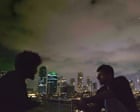
Their faces in shadow, appearances and voices digitally altered, disillusioned Israeli intelligence officers and personnel speak to the directors about the war in Gaza. They do this semi-furtively on the dark night-time rooftops of Tel Aviv, the home of Israeli intelligence, supposedly for journalistic secrecy purposes – but it also provides a dramatic backdrop, as well as ambient footage of the city in all its eerie heedlessness and heartlessness.
Periodically, the camera’s eye will drift across the gleaming apartment buildings, zooming in on glimpses of prosperous lives just 60km from Gaza.
The interviewees reject the whole concept of “human shields”. They allege that it is not a question of Hamas operatives hiding behind civilians; rather, Israel’s intelligence services have subcontracted their attack recon to AI.
A computer program reportedly analyses the call pattern on phones belonging to known Hamas terrorists and finds which of the other tens of thousands of phones they have under surveillance exhibit the same tendencies – and then attack the owner, invariably at night, in the apartments whose whereabouts are already minutely documented by the state. A 15% permitted “error” rate for this is mentioned at one stage, and another respondent talks about an expected “Naza” rate of 20 for each action – but clearly this is elastic to say the least.
Gaza’s civilians are considered to be all tacitly complicit in the grotesque antisemitic pogrom of 7 October, and whole buildings and vast numbers of people can be wiped out in one computer-generated assault.
Elsewhere, the officials talk about the logistics involved in “cleansing” northern Gaza and in sniper attacks on Gazan civilians who, desperate for food, don’t know they have crossed some invisible line into a militarised zone. Another part of the film talks about an intelligence unit unofficially loyal to prime minister Benjamin Netanyahu personally, engaging in dirty tricks undermining international human rights bodies who might be antipathetic to Israel’s political leadership.
The ahistorical comparison to nazism is inevitably and glibly invoked by one speaker. But Gaza, however horrendous, is not the same as the Holocaust. This specious parallel is all too readily available; the bombing of Dresden is the more obvious comparison. At all events, the anguish of Gaza is brought into pin-sharp focus.