
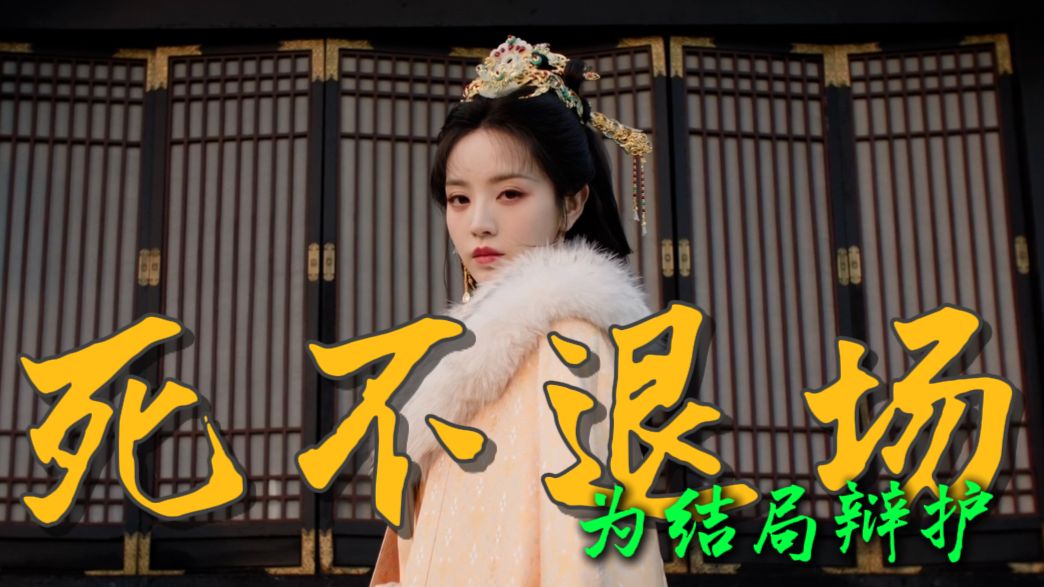
The plot of "Marrying the Golden Hairpin" doesn't hold up to close scrutiny, but I want to say a few words in defense of its ending. Hello everyone, I'm Scar Butterfly, and in this episode we'll discuss the controversy over the ending of "Marrying the Golden Hairpin."
The early part of this drama mixes all kinds of elements: real and fake daughters, substitute brides, marriage before love, mother-daughter relationships, and succession struggles. To be honest, I don't like this rough and over-the-top texture, but I also don't think the ending is mindless wish-fulfillment.
Currently, the most criticized aspect of the ending is the claim that once the female lead backs the posthumous son, the feudal princes can immediately use the pretext of "purging evil advisors from the throne" to eliminate her. This view, along with the interpretation that the final shot hints at the female lead becoming empress, both stem from a misunderstanding of the plot—and both are classic examples of the ingrained assumption that "the protagonist must win."
The underlying logic of the "purge the court" criticism goes: because backing a posthumous heir would most likely fail in reality, the plot is unreasonable, and therefore the screenwriter is ignorant. But the problem is that the vast majority of real political participants were never the final winners—especially women. "Winners become kings, losers become bandits" is an extremely narrow view of history.
What does whether a character's choices within a power structure hold up have to do with her probability of winning?
To put it plainly: in history, among those briefly mentioned cases of failed attempts to enthrone a young heir, shouldn't their mothers and aunts have fought to the death to defend their own interests? Should they have simply knelt down just because the odds were against them? Whether the feudal princes' purge succeeds and whether the female lead fails is a separate question.
But by giving the female lead a posthumous son as leverage, and having her prepare to defend her own interests at the story's end, the screenwriter both conforms to the institutional logic of defending legitimacy and to the moral standards required of righteous characters in popular storytelling, while also establishing a new paradigm for modern female-oriented wish-fulfillment fiction.
We've seen many narratives where the female lead enters the center of power through her status as wife or mother, because this is indeed the approach most consistent with history. Why are costume dramas for female audiences so hard to write? Because the entire ancient world was male-oriented fiction writ large.
In the past two years, "Empresses in the Palace" and "The Story of Minglan" have both come under scrutiny, because this type of narrative easily triggers modern women's anxieties about marriage and childbearing: when mass media repeatedly shows that ancient women could only gain power by attaching themselves to men, the more realistic the palace and household intrigue, the more this dependency gets projected onto modern logic—what's called "big-outcome literature."
Of course, there's also the Mary Sue-style wifely power, represented by "Schemes of a Beauty": Dou Yifang's power base came entirely from Liu Heng's choice of "the beauty over the empire." Before her death, Empress Dowager Bo said that she possessed both her husband's complete love and supreme power, and besides the male lead's lifelong devotion without ever owing each other anything, she also had the male second lead's silent protection. The advantage is that the spotlight is concentrated on the female lead—it's a very effective female ensemble where men are tools and background props—the CP popularity didn't even match that of Dou Yifang and Nie Shen'er.
This is also a type of female-oriented wish-fulfillment fiction, but it is unquestionably still based on the identities of wife and mother.
In recent years, costume drama heroines have begun to be given the identity of Grand Princess, which can be seen as an attempt to break away from dependence on wife-and-mother identities. I've never had high standards for costume dramas, but "Qiao Chu" previously had logic flaws that were too obvious: the heroine traded a vow of lifelong celibacy for the emperor's deathbed appointment, ruling from behind the curtain as the Grand Princess Who Guards the Nation—she had no blood relation to the young emperor, while her father commanded 200,000 troops.
This is highly abnormal and contrary to human nature.
But "Marrying the Golden Hairpin" spent over 30 episodes establishing that: Wei Rao has a prince with a blood relation to her, she has political allies by her side, and she has a foundation of popular support. The narrative across those 30-plus episodes is indeed rough, heavily reliant on exaggerated dramatic conflict, but compared to "Qiao Chu," Wei Rao's power clearly has a source and a foundation.
At the very least, structurally it presents this: power is not a tool that can be obtained directly through bestowal—it is a person's position within a network of relationships. To put it bluntly, power is about which people, under what conditions, will stand on your side, and what a dramatic story must do is make "why these people stand on your side" internally coherent.
However, I should make clear that this video focuses solely on the ending; controversies about the earlier plot are outside the scope of this discussion.
As for the final ending pose, some interpret it as ascending the throne as a female empress, only prevented from being filmed due to censorship. I don't rule out that the creators deliberately created this illusion, but I believe it's a misreading: the female lead clearly lacks any conditions for enthronement at this stage—she is merely the spokesperson of the interest group centered on the posthumous son. Given how the ending is set up, it's essentially a princes' rebellion in the making.
Another point of comparison: "Qiao Chu" still ended with returning power to the young emperor and living happily with the male lead. And that's what I want to say: compared to wife-and-mother power narratives, the costume dramas for female audiences with fewer marriage and childbearing anxieties are actually those where the heroine gives up power, distances herself from power, returns to family, and retreats to the mountains—these phrases should remind you of the endings of many dramas.
Behind them always lies the discipline of "girls shouldn't touch political power."
In "Blooming Flowers," the heroine uses divorce as a threat to demand the male lead resign, and in "Orchid Fragrance As Before," consummating the marriage is even treated as a reward for the male lead's resignation. Power serves my purposes, but I will eventually exit—this is repeatedly packaged as a happy ending in female-oriented fiction, but it's really just instrumentalizing power, then exiting with moralized grace.
It seems a female character can enter the arena of power—otherwise the story has no draw—but she must leave at a "correct" moment, so that her choices appear more "wise."
On this point, I really appreciate the quality of "The Story of Minglan": in the finale, Minglan says she wants to live a plain, uneventful life, but she herself knows that's no longer possible. Giving birth amid a fire, beating the drums during her postpartum confinement—these were the price she paid dearly for wanting to be "somebody among women." Throughout the entire post-marriage arc, Minglan has a kind of grit of "this is the path I chose, and I'll crawl through it on my knees if I must," never looking back.
Whereas those heroines who choose to withdraw from and distance themselves from the center of power all carry a kind of moral disclaimer: the power was borrowed, I've already returned it, so I haven't been corrupted by power, and I remain clean. This moral fastidiousness is inherently at odds with power struggles.
If "Marrying the Golden Hairpin" continues further, the female lead will have to make political choices. I also think her odds of winning aren't great, but they're not hopeless: on one hand, Wei Rao isn't alone—she's a political alliance. The Lu family, the Xie family, Zhou Fu—they don't lack political resources.
On the other hand, the thirteen feudal princes are not a monolithic bloc. The Grand Empress Dowager favors Prince Rong, and once Prince Rong becomes tied to the succession, he becomes an even greater threat to the princes: originally, if the princes rebelled together, they could wait until success to divide the spoils and fight over who's boss.
But if the outcome is already decided in Prince Rong's favor before the rebellion even starts, who would be foolish enough to pull chestnuts out of the fire for him? Once he ascends the throne, he will inevitably consolidate power to prevent the next Prince Rong from appearing.
This principle is simple: a single persuader only needs to lobby some of the weaker lords, and effective division follows. Once even a small crack appears, other possibilities emerge—it becomes negotiable, and therefore seen as controllable. A widow and orphan have always been considered easier to manipulate, and a posthumous son is merely a figurehead—everyone knows this well enough.
Beyond negotiation, a genuine existential crisis could also force the posthumous-son faction to make more concrete promises of interest to the lords—for example, ceding parts of central authority and resources in exchange for their neutrality or defection. This might be driving the tiger to devour the wolf, or it might be drinking poison to quench thirst.
But real political struggle carries neither so many moral demands—all that talk of a carefully crafted image collapsing—nor so many guaranteed victories. Everyone just takes it one step at a time, surviving tonight before worrying about tomorrow. Yet this kind of gray deal, trading power for survival, is probably something neither the censors nor the audience could accept—it would already fall outside the scope of a costume romance drama.
The posthumous son at the end of "Marrying the Golden Hairpin" gives the heroine a final thread of hope, but the abrupt ending does seem like a botched finish in terms of narrative flow and completeness: the audience expects the protagonist to win, yet the story stops at a point where the odds of winning are slim, making that final, almost-coronation ending pose feel jarring and contradictory.
However, from the perspective of an ethical shift in female power narratives, I think this ending makes a good start for a new paradigm in female-oriented fiction: first, power in female-oriented stories need not depend on wifehood as the ticket of entry—and especially with the loosely regulated social mores of the Han dynasty as a backdrop, there is great creative space for heroine-centered politics. Moreover, the power narrative is no longer just a backdrop for romance—notice that at the ending, no one is even discussing her love life, which is already a breath of fresh air.
I agree that the heroine's odds of winning were slim. But so what if she lost? If you're going to write a power struggle, then the heroine should die within that power struggle.