
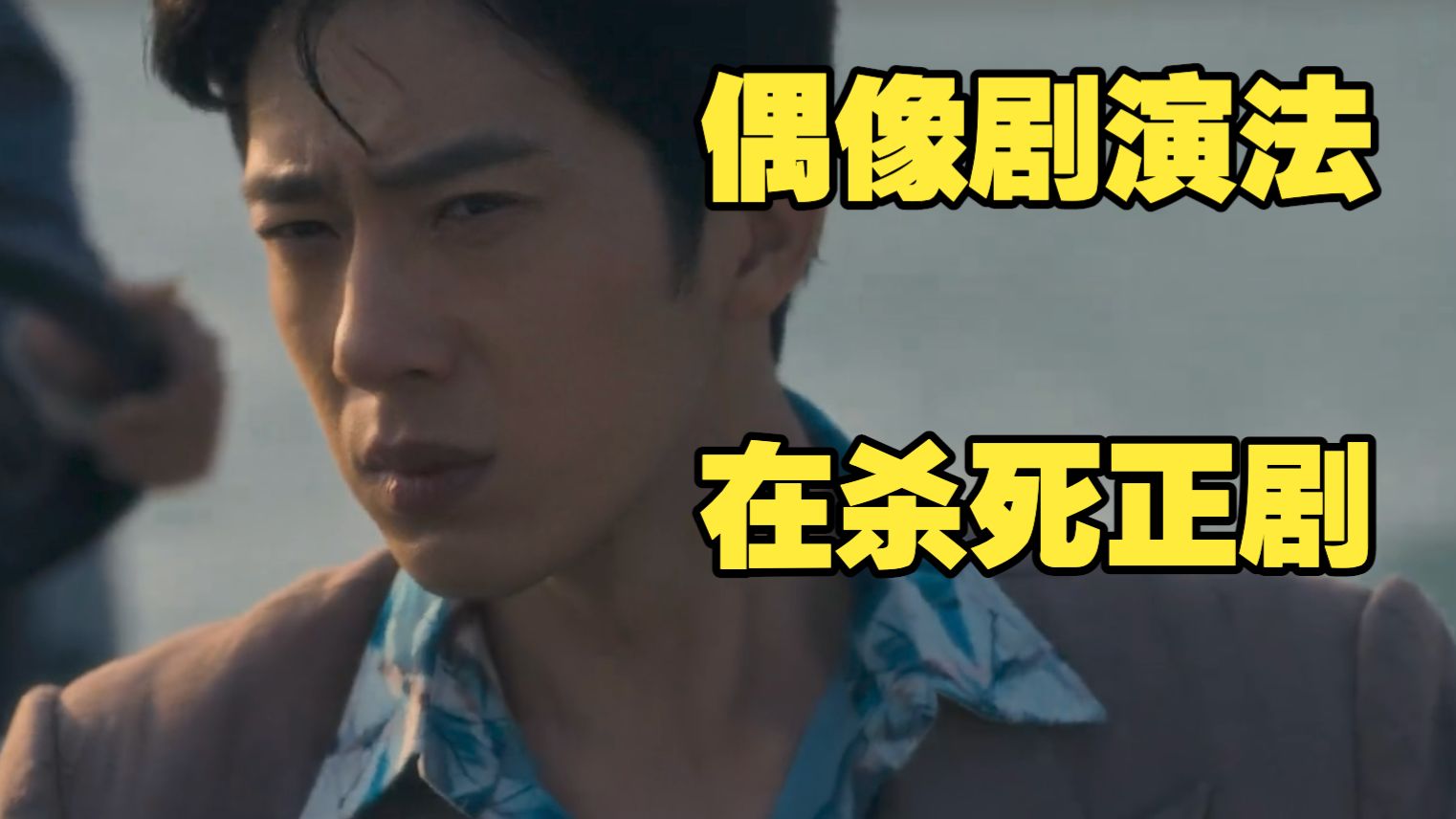
Mediocre acting isn't scary—what's awkward is running into true acting veterans. Three men make one drama: some act with penetrating depth, some are so cringeworthy your toes curl into the floor. Some are performing real life, some are performing an idol drama.
Some lack talent and rely entirely on effort, while someone's emotional shifts are as sudden as a thunderclap on a clear day. This is evidence with the tax bureau personally guiding the production—so why must you insist on staying in your comfort zone, chattering away and showing off? Where are those overexerted eyebrows and eyelids of yours?
Hello everyone, I'm Fusheng, your male best-friend uploader with 200,000 followers who begs you to like, coin, and favorite, and nags those who haven't followed yet. Today I want to talk about the tax and economic-crime investigation drama "Gu Yu" (Ancient Words), starring Jing Boran, Zhang Songwen, and Sun Yizhou.
Let me state my conclusion first: by domestic entertainment standards, compared with the piles of idol dramas flooding the market where characters kill each other without mercy, this one is actually watchable. But while the subject matter and plot constrain things, there's no stopping some people from still acting like it's an idol drama. Yes, I mean Mr.
Jing Boran, who just finished playing workplace bullying disguised as a domineering-CEO romance. Honestly speaking, amid the swamp of domestic acting, his skills can barely count as a plain. As long as he doesn't play a C-position character like Lu Ke, the viewing experience is at least tolerable, if not acceptable.
But the problem is that the other two lead actors of this so-called plain are one sacred mountain and one of the Five Great Mountains—by comparison, you still look dull. The other two are earnestly performing a serious drama,
and you're the only one who isn't, making me hallucinate a hot-blooded shonen manga, or feel like Lu Ke hasn't quite been forgotten. The other two strive for authentic, natural line delivery, while you're still stuck at exaggerated intonation and haven't even finished memorizing your script. Even if you pass, sandwiched between two 80-point performances, you're still the textbook example of breaking immersion.
Next, Fusheng will give everyone a detailed sharp review of this drama. Spoiler warning: the following is only my personal opinion, targeting only character construction and the actors' performances with reasonable criticism. My anger and harsh words are aimed only at plot construction and acting methods, not at attacking or defaming any real person.
Please judge rationally.
Buckle up and hold on tight. The drama opens against the backdrop of 1994, when the state cracked down on counterfeit VAT invoices, telling the story of tax officers cooperating with public security police to combat the illegal manufacture and resale of invoices. Jing Boran plays tax inspector Ouyang Xu, and Zhang Songwen plays a Gao Qiqiang-style character—in this drama called Zhou Haiyang.
The three meet through a case and become sworn brothers. Twenty years later, Zhou Haiyang has degenerated into an economic criminal, and Yan Ping'an and Ouyang Xu begin investigating economic crimes connected to him. First, let me briefly gripe about the TV adaptation's changes to the novel's plot.
All I can say is that the "wanting it both ways" disease of domestic entertainment isn't limited to idol dramas.
There's evidence for everything—it's just a matter of degree. In the original novel, the tax police and this criminal had absolutely nothing to do with each other, let alone any life-and-death brotherhood. I honestly don't understand why they had to create a falling-out between a cop and a criminal who were once brothers.
I discussed this with my police friend, and he hit the nail on the head. He told me: "I grew up with you because we share values and interests. If you turn to crime, it proves our values don't align—and when that happens, I'll be the first to arrest you.
I won't feel pain or be torn about it." Worse still, the script simply doesn't have the length or the ability to build up the three men's brotherhood.
It's not as if helping each other out and adding a life-or-death suspension-bridge incident makes you sworn brothers. Qiong Yao could use two episodes to turn Xiaoyanzi and Ziwei from strangers who met by chance into sisters who would die for each other. Of course you need events to push things along, but the key is that the events only give them a chance to meet.
What truly makes them sisters is a resonance of souls and mutual admiration—Xiaoyanzi admires Ziwei's talent and kindness; Ziwei admires Xiaoyanzi's freedom and chivalrous spirit. That's the real root of their bond. But the three men in this drama barely know each other, may not share values, and may not share interests.
Their brotherhood feels like this: constantly going "sworn brothers, you and I are brothers now! "—and then, whoa, stop right there. For example, Zhou Haiyang and Ouyang Xu meet because Ouyang Xu helps him get back a bag snatched by a motorcycle gang.
The two chase the gang into a courtyard, perch on the courtyard gate while the gang taunts them from below. Here the screenwriter wrote an incredibly cringeworthy scene: the two, sitting on the gate, exchange a glance, smile, and mutter, "When forbearance reaches its limit, no more forbearance—fight! "—then whoosh, they charge down.
Am I watching a hot-blooded Japanese manga? Isn't this an economic-crime investigation drama? Why?
Why does it suddenly turn into this? So embarrassing. After that, it's nothing more than Ouyang Xu giving Zhou Haiyang some money to help him out, and during the investigation the three together defeat the criminals in a life-or-death showdown.
All I can say is: if that's all it takes to become sworn brothers, then every veteran detective in real life must have brothers all over the world. Would it hurt to just film the original novel faithfully? Even if you wanted to give this criminal an arc of a small-time nobody turning dark, just build his personal storyline properly.
Why insist on the brothers-turned-enemies angle? Their bond was never that deep anyway. Now, about the adaptation of Zhou Haiyang's character.
In the novel,
this character isn't even named Zhou Haiyang. The TV version built him from the Gao Qiqiang template: likewise a small-time man of humble origins who, through being bullied and deceived, gets drawn into crime, then gradually degenerates and chooses to do evil willingly.
At this point I understand why the screenwriter insisted on adding the brothers-turned-enemies plot: without that relationship, he'd be exactly identical to Gao Qiqiang. Many viewers say Zhang Songwen's performance here is no different from Gao Qiqiang. But what I want to say is: it's very hard to play a difference.
The character setups are nearly identical. And it's an ironclad fact that Zhang Songwen is not a so-called naturally gifted actor. His way of interpreting characters has a kind of unpolished clumsiness.
He puts in tremendous hard work to compensate, designing many small details for the character: when Yan Ping'an stuffs money into his hand, his eyelids twitch wildly to show the character's resistance and hidden strong self-esteem; he smooths his hair to convey the character's compassion. You could say he has pushed "diligence makes up for lack of talent" to its extreme—but for the part diligence can't fix, he's powerless.
Script quality is another major factor. Often it's not that Zhang Songwen's acting is homogenized, but that the roles he receives are homogenized. The current reality of domestic entertainment is that whenever a Gao Qiqiang-type role comes up, apart from C-position traffic stars, capital thinks of him first.
When Zhang Songwen wants to challenge other types of roles...
It's unlikely he'd ever get the chance anyway, but at least he can complete the task. He basically never took me out of the story, and he's not annoying—which, in today's domestic entertainment industry, is already rare and precious. But when it comes to the other lead of this drama, I can't be quite so forgiving.
That's Jing Boran, whom I mentioned at the start. If Zhang Songwen's somewhat clunky delivery is due to a lack of natural talent, then Jing Boran is the opposite extreme: he overdoes everything, with a standard idol-drama acting style. First of all, twenty years ago, Ouyang Xu was supposed to be a so-called hotheaded young man—daring to charge ahead, with a youthful arrogance.
The problem is that Jing Boran himself is already half middle-aged.
So whenever he tries to show that youthful sharpness, he unconsciously carries a certain middle-aged flavor. It doesn't look like a young man throwing a tantrum; it looks like a middle-aged man sulking. As for his lines: the everyday, conversational ones are fine, but once he hits expository lines—especially those re-dubbed in post-production—he starts reading off a script.
It was so awkward to listen to. There's a scene where he and Sun Yizhou interrogate a criminal. As a tax officer, he's supposed to summarize how much national tax revenue the criminal's counterfeit invoices stole.
The entire thing is delivered like an AI reading a script, with no detectable emotion. The worst part is the final line: 'Four hundred million—you people are simply insane! ' Come on, buddy, you're playing a living, breathing character,
not chairing a meeting or narrating an audiobook. Aren't you supposed to be calling him insane? Where's your accusation and anger?
Compare that with Sun Yizhou's original-voice lines—it's like hearing heavenly music. 'Did you catch that just now? No?
Then I'll read it to you again.' In this scene, they're posing as two Taiwanese tycoons to fish for information from the criminal. Jing Boran plays the good cop, Sun Yizhou the bad cop, and Jing Boran needs to show anger. The actor playing the criminal Li Guangzong is a Hong Kong actor.
Let me put it this way: of the three, one is acting in a Hong Kong drama, one in a serious drama, and one in a short-form web drama. Jing Boran's anger always comes out of nowhere,
and his way of expressing it is just glaring and shouting at the top of his lungs—extremely thin and one-note. With the same big emotions, the Hong Kong actor's performance has a full arc—setup, development, turn, and conclusion—and when he gets worked up, the veins on his forehead actually bulge, proving he's exerting effort in the right place.
Jing Boran, meanwhile, just glares and yells, never responding to his scene partners, keeping his pitch at maximum the whole time with no rise or fall, expressing only the emotion he wants to express. And when threatening someone, he even does what I'd call a 'sexual-harassment-style' bit of getting up close and personal. That's an idol-drama domineering CEO, not a Taiwanese tycoon.
Everyone else's emotions have transitions;
his emotions are just wide-open swings with no turning points. His performance is completely out of control. In a scene that fits together seamlessly, he's like a gear that never quite catches the right position.
Look at that expression—rather than anger, it looks more like the terror of someone who's been groped. There's another scene where, after they enter the counterfeit-invoice factory compound, they unexpectedly run into Zhou Haiyang. They want to hint to Zhou to cooperate with them.
Ouyang Xu says to Zhou: 'I believe Old Zhou can handle the printing problem. We've come a long way to find this place—it wasn't easy. I believe in fate.
Do us a favor.' Personally, I think the tone here should be that kind of feigned casualness, something very relaxed:
'I'm sure Old Zhou's got it covered. We came a long way to find this place, you know. I believe in fate—help us out, yeah?
' But Jing Boran plays it like Liu Bei entrusting his orphaned son—extremely solemn, extremely earnest—a completely different emotion from his earlier irritable, hot-tempered characterization. 'I believe in fate, help us out.' Honestly, if I were the criminal, I'd have to ask: 'Do you two know each other? You're pretty close, huh?
' It's way too bizarre, way too obvious. Don't treat criminals like fools, okay? Finally, I want to give special praise to one lead's acting: Sun Yizhou, who plays Yan Ping'an.
He feels like the kind of actor who has some talent and is also willing to put in the work. His performance back in the iPartment days was already impressive,
and in recent years he's done quite a few serious dramas and films, all with commendable results. Take the scene where Ouyang Xu hints to Old Zhou: Ouyang Xu suddenly gets the idea to drop the hint, and Sun Yizhou's performance is packed with detail. Within one second, his gaze shifts three times—from 'what the heck is this kid trying to do,' to weighing the feasibility, to finally relaxing with relief.
Not a single detail of the performance feels suspicious; it's all grounded in genuine emotion, and the calibration is just right. Then there's the scene where he handles the escort girl sent by the criminals, pretending to be aroused. In the medium shots, you can see he plays that 'getting carried away' feeling very convincingly, which fits the character well.
In that era,
Yan Ping'an, as a criminal police officer, must have arrested plenty of people and observed their states. When the camera cuts to the extreme close-up, you can see that within his feigned eagerness and crazed eyes there's a hint of probing. What touched me most was the scene at the end of the big case twenty years ago, when Yan Ping'an invites everyone to eat at the rice-noodle-roll shop his mother runs.
Sun Yizhou and the veteran actress Lyricist Wong (Yuen King-dan) play mother and son, and their scenes together are very natural and full of life. It's not convenient to show the original footage here, but if you're interested, go check the beginning of episode five.
Lastly, I want to say: in today's domestic entertainment industry, idol-drama stars and so-called actors—traffic celebrities—don't really put their hearts into honing their craft.
'Jinjiang-style acting' and 'domineering-CEO-style acting' keep emerging. If they can't even act in idol dramas, let alone serious dramas. Maybe it's time to leave professional matters to professionals.
Or, failing that, at least give some newcomers a chance to show their faces. Don't make me watch a domineering CEO glaring and raising his eyebrows beside me while I'm trying to enjoy the everyday warmth of street life and naturalistic acting. That's it for this video.
If there's anything else you'd like me to sharply review or break down, feel free to leave it in the comments or send me a private message—I'll be your mouthpiece on the internet. See you next time. Bye-bye!