
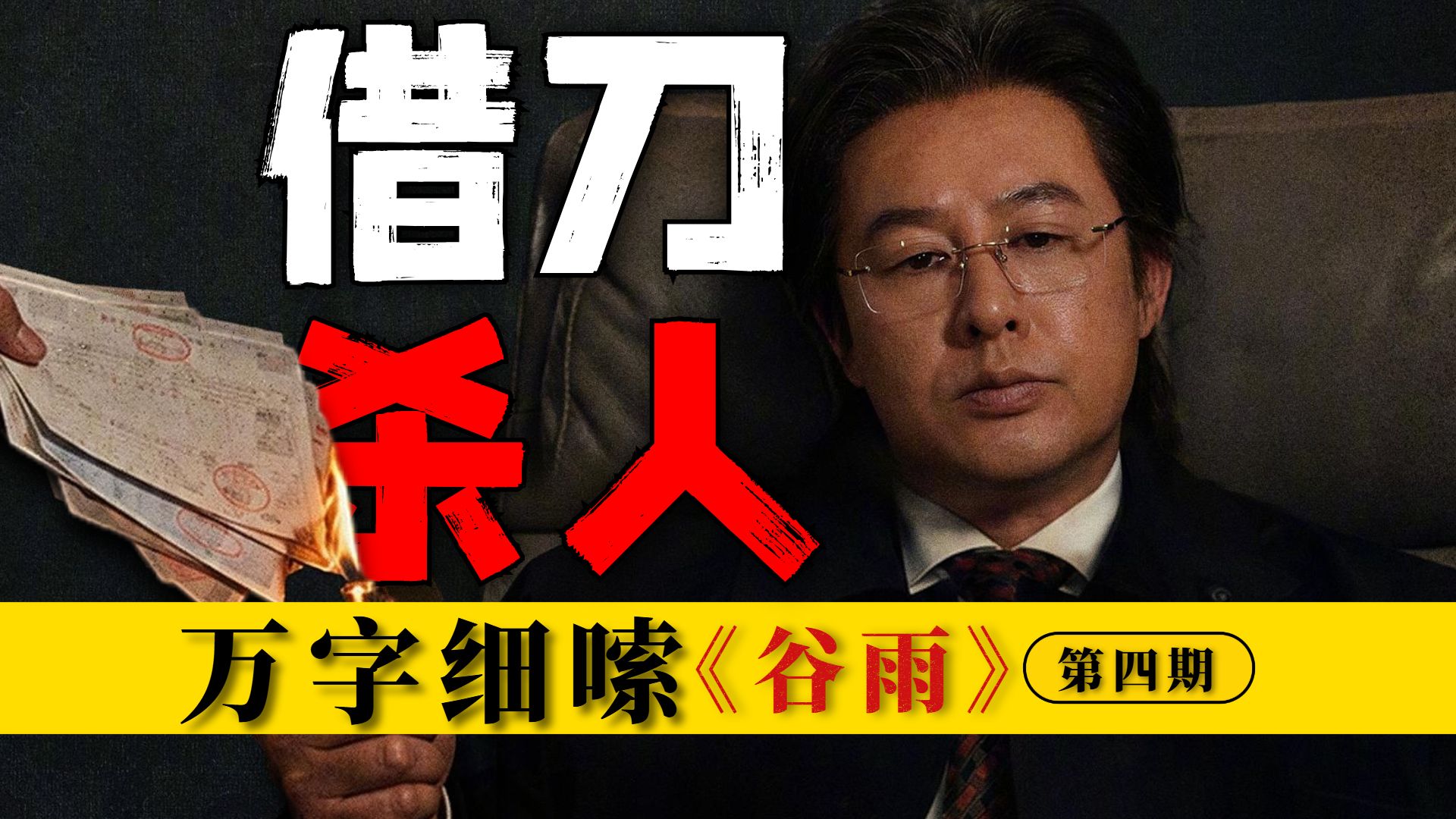
His name is Zhou Haiyang. Six months ago he was so poor that when he got his shoes repaired, he could only afford to spend one yuan. Now he wears a sharp suit and lives in the manager's office of Dongle Manor. Every side believes he is one of their own, and every side schemes alongside him: the police's blade, the tax bureau's ledgers, the gang's guns, the money house's cash.
He stands right in the middle, with no intention of paying any of them back. This game of chess has only just entered its middle game. Today we continue the story in episode four of "Grain Rain."
Hello, I'm Tutu, the man of few words. I update "Grain Rain" daily—please give me a like, coin, and favorite to help me recover some HP. Like first, then watch. Love you.
Last time, we learned that the police and the tax inspectors had both set their sights on Sister Hong's Dongle Manor. Dongle Manor had long been suspected of laundering dirty money, but Ouyang Xu's mentor, Old Zhang, refused to let him investigate deeply—the waters around Dongle in Chunjing run very deep. To investigate behind Old Zhang's back, Ouyang Xu turned to Miss Tang, his former teacher from tax school.
Unexpectedly, the moment Miss Tang walked in, Chen Tianbao saw through her at a glance and exposed her identity. Fortunately, Ouyang was following behind Miss Tang today, and the police were also staked out around the manor, which allowed Ouyang Xu and Yan Ping'an to reestablish contact.
As soon as they heard that Miss Tang had been taken by Chen Tianbao to a hotel room, Xiao Yan and Ouyang discussed the need to rescue her immediately. But how? Just as Chen Tianbao was giving Miss Tang a hard time, a knock sounded at the door—a underling quietly told Brother Bao that another wave of police had arrived downstairs. Apparently the police had visited Dongle many times already, and this forced Brother Bao to show up in person, which finally got Miss Tang out of danger.
After leaving the hotel and returning to the city, the two quickly exchanged information. Today, Miss Tang had specifically checked at Dongle's front desk on how memberships were handled: these membership cards cost anywhere from several hundred thousand to several million yuan. Several million RMB in 1994—what enormous financial power would that require?
Would a rich person really need a membership card worth millions? So Miss Tang suspected that Dongle Manor was laundering money behind the scenes—the very purpose of the place was to clean money from Hong Kong gangs. As for how the invoice business later developed out of it, that remains unknown and requires further investigation.
At the same time, something major happened at Dongle Manor tonight on Sister Hong's side: her daughter Lin Ruyi had been kidnapped. She told Brother Bao to ransom Ruyi—the 300,000 yuan ransom would be paid—but Sister Hong had to know who was behind it.
Brother Bao was quite confident and didn't even take the ransom, because he had another clever plan: when it came to rescuing Lin Ruyi, Brother Bao didn't go himself, but handed this tough assignment to Zhou Haiyang, sending him to the song-and-dance hall with a case full of cash to ransom the girl.
Today, doing a job for Brother Bao gave Old Zhou a sense of confidence—this was a good opportunity to submit his pledge of loyalty. Lin Ruyi was locked in an iron cage at the song-and-dance hall. Red-haired street girls, all present at the hall—so this was the right place.
Old Zhou handed over the money and asked for the girl's release in exchange, but then things suddenly went wrong: when the case was opened, they suddenly beat Old Zhou brutally—the case contained only a few magazines and nothing else. Brother Bao had actually set Old Zhou up!
Several bottles were swung at his head, and Old Zhou's scalp was split open on the spot. That wasn't the end of it—while Zhou Haiyang was still unconscious, the punches and kicks never stopped. But how could a few thugs' strength compare to Sister Hong's sedan? Old Zhou is the athlete who could take a dump truck head-on.
After leaving the dance hall, the two hailed a taxi. Lin Ruyi didn't want to go home, so the cab drove toward a motorcycle club by the sea. It was from this club that Lin Ruyi had originally been kidnapped. She had plenty of friends there, yet when she was actually kidnapped, no one helped her. This infuriated Lin Ruyi greatly—she beat up her friends and snatched back the motorcycle keys, finally venting her anger.
Riding the motorcycle at full speed, they went from the city to the seaside. Finding a deserted spot, Old Zhou suddenly pulled out a ring: earlier, when Lin Ruyi had no money for the taxi, she had pawned her pure gold ring to cover the fare. Later, Old Zhou decided this wasn't a good deal, so he paid the fare properly and redeemed the ring.
With this gesture, Lin Ruyi saw Old Zhou as her dark-horse prince, gave him a kiss, and rode off. What on earth was that? Didn't she see Brother Bao sitting right behind them!
Lin Ruyi may have left, but how would Old Zhou account for this to Brother Bao? He could only force a smile and pretend nothing had happened.
"If you want a future, you have to risk your life for it. I can't take this money." No money pouch—one old friend of mine who sells fish told me: Brother Bao left, and Old Zhou had truly passed this test.
Brother Bao has a habit: he especially loves testing people. The fact that there was no money in the case shows that Chen Tianbao had confidence—Lin Ruyi was definitely not going to come to harm. And since he had that confidence, this kidnapping was very likely staged by Chen Tianbao himself.
For instance, when Sister Hong questioned him earlier, asking whether he had heard some rumor, and saying "I must know who did the kidnapping"—once she knew where the kidnappers came from, Sister Hong could investigate afterward herself and verify the truth of Brother Bao's words. Sister Hong was probably somewhat uneasy about Chen Tianbao too; when she said this, the camera specifically cut to the perspective of one of Brother Bao's underlings, so this kidnapping was surely inseparable from Brother Bao.
Therefore, to avoid Sister Hong's later investigation, Brother Bao hacked the kidnapper to death—killing to silence the witness, cutting the thread clean.
Sister Hong was testing Chen Tianbao, but Chen Tianbao used the kidnapping to test Zhou Haiyang, to see whether he was a cop—a cop wouldn't dare torture someone with electrical wire nearly to death. Zhou Haiyang's pledge of loyalty was thus submitted: no money in the case, so this was an exam.
In the end, Brother Bao took out a large sum of cash as a reward for Old Zhou, but Old Zhou refused it—he couldn't collect a settling-in fee for doing just one job for the boss; he still had a long road ahead in this world. As a bonus, Brother Bao could see that Zhou Haiyang and Lin Ruyi had some mutual flirtation going on, but he said nothing.
Because Sister Hong and Chen Tianbao essentially belong to two different factions, if Zhou Haiyang proved trustworthy, then Zhou Haiyang getting closer to Lin Ruyi would do Brother Bao no harm at all.
The next day, Sister Hong was quite pleased with Brother Bao. Now that Lin Ruyi was back, everything could be smoothed over. The underling who had rescued Lin Ruyi last night happened to be outside, so he was brought in to greet Sister Hong. "Call her Sister Hong." "Sister Hong." "What should I call you?" "My name is Zhou Haiyang." "On a first meeting, Sister Hong must welcome you and thank you for saving Ruyi." "It was nothing." He's a decent fellow—see if there's any opportunity for him at Dongle.
Keep in mind, when Zhou Haiyang first joined Chen Tianbao's crew, he immediately told Brother Bao that he had a grudge with Sister Hong: he had once printed invoices for her, and she had then turned around and tried to silence him. This meant Brother Bao now knew Li Ahong's dirty history—privately printing invoices and quietly expanding, all of which violated the gang's rules on the mainland.
But Brother Bao didn't say it outright; instead, he had Old Zhou call her "Sister Hong" the moment he walked in, as if Chen Tianbao knew nothing of the two people's past. This left Sister Hong with no choice but to play along, asking "What should I call you? "—meaning she would suppress and bury the matter of the privately printed invoices.
Bao Ge just wanted to watch Li Ahong's reaction: to see what expression she would have upon seeing Zhou Haiyang again, and what she would say. Now things were clear—Sister Hong really did have a guilty conscience, which indirectly proved that Zhou Haiyang hadn't lied: everything he had revealed about Li Ahong's criminal past was true.
At this point, Lin Ruyi came in. Lin Ruyi was quite close to both Chen Tianbao and Zhou Haiyang. With Lin Ruyi vouching for him, saying that Zhou Haiyang was a really decent guy who had risked his life to save her the night before, both the daughter and Bao Ge had spoken up. Sister Hong had no choice but to go along and compromise, initially giving Lao Zhou a position as business manager, keeping Zhou Haiyang inside Dongle Manor and using the manager's title to seal his mouth.
The more evasive Sister Hong's words became, the clearer things became to Chen Tianbao. He treated Lao Zhou like a rat dropping, placed right beside Sister Hong to disgust her. When the snipe and the clam grapple, the fisherman profits in the end.
Dressed in a suit, Zhou Haiyang had truly made something of himself, full of confidence and vigor—last time he came to the manor he was a small-time nobody, and now he was a manager. He was quite satisfied with this outcome, unable to keep the corners of his mouth from curling up, happy as could be.
Little did he know, ever since Teacher Tang went back last time, Ouyang had been set on taking on Dongle Manor. He was convinced there was something wrong there, and once again, without notifying his own bureau, he privately brought people over to inspect the accounts. When the tax bureau comes to audit the books, it's naturally the manager who receives them.
Li Ahong would never show her face, so she claimed the boss was away and the accountant was on vacation, trying to drive the tax officers off. The moment the reception staff appeared, Ouyang spotted Zhou Haiyang in the crowd. Two or three months had passed, and seeing Lao Zhou again, he had already climbed this far—something Ouyang had never expected.
Today's audit went very poorly: because the tax bureau had already come once before, under the pretext of land-use issues, and found nothing. Now they were checking again, and since Ouyang had come privately, Dongle Manor flatly refused to cooperate, refusing to allow any inspection no matter what. He had no way around it.
As for Lao Zhou on the other side, the man before him made Ouyang feel like a complete stranger. When the other party reached out to shake hands, Ouyang remained unmoved, leaving Lao Zhou quite embarrassed. They used to be brothers; then the brother landed a cushy job and stopped acknowledging his brother. Still, this wasn't a good place to talk, so Lao Zhou gave Ouyang a squeeze, meaning they'd talk another day.
Outside, the tax bureau found nothing in the books; inside, Bao Ge wasn't idle either. Taking advantage of the moment, he cornered Sister Hong in a room—he too wanted a look at Dongle's ledgers. But what Sister Hong produced was the external account book—the hotel operations, the club revenues.
What use was looking at those? She was playing dumb while knowing perfectly well. What Chen Tianbao wanted to see was Sister Hong's sales ledger: with so many bars across the country, and so much liquor shipped in from Guangdong every day, Sister Hong packaged smuggled foreign liquor with invoices and sold it nationwide as legitimate goods.
In effect, Sister Hong was almost making something from nothing—she was just a middleman, a second-hand dealer. The liquor came from Hong Kong, and the manor operation was something the Hong Kong triads allowed her to run behind the scenes. Through the single step of invoicing, Sister Hong marked prices up two to three times, yet the profits she handed back to the Hong Kong backers remained unchanged.
That was why Bao Ge had to step forward on behalf of the society and personally ask Sister Hong whether they could get rich together.
The answer was no. Li Ahong said outright that she wasn't willing. If she wasn't willing, there was nothing to discuss, and Bao Ge rose and left. It seemed Sister Hong intended to break with the society entirely—and this was probably why Bao Ge had to plant Zhou Haiyang inside Dongle Manor.
As mentioned earlier, before Ouyang left, Lao Zhou had quietly said, "Ten tonight, the usual place." This "usual place" referred to Yan Ping'an's home—Xiao Yan's mother ran a restaurant that served rice noodle rolls and hotpot. Meeting here inevitably brought to mind the late Big Brother Gao, who also loved this food.
That said, when Zhou Haiyang left Chunjiang last time, the court had given him residential surveillance, which in principle should not have left a criminal record. But what happened? The Haichao Printing Factory case was made a national example, with the verdict demanding strict and severe punishment, so Lao Zhou ended up with a record anyway.
When he went to apply for a Hong Kong-Macau travel permit, he needed the neighborhood committee to issue a certificate, but with a case hanging over him, the committee wouldn't deal with him. Now he couldn't go to Hong Kong, and he couldn't find his wife either.
Xiao Yan and Ouyang had previously sworn they would definitely help Lao Zhou earn credit for meritorious service so that no criminal record would affect his future. Now, as far as Zhou Haiyang was concerned, there was no future to speak of, and his words carried resentment. The two brothers before him—one from the police, one from the tax bureau—were, in principle, both thorns in Dongle Manor's side. Meeting them privately, Lao Zhou had to watch his mouth carefully.
Ouyang Xu said: "I ran into you at Dongle today—how did you end up at Dongle?" "A friend introduced me. They said it's a Hong Kong-invested enterprise with lots of Hong Kong clients. Since I can't get to Hong Kong, if I could befriend one of those Hong Kong clients, then when he goes back, I could give him my wife's photo and ask him to help me look for her in Hong Kong. By the way, you work at Dongle, don't you? Have you seen this person?" Looking at the photo of Bao Ge, Lao Zhou fell silent.
Zhou Haiyang returned home. He had recently been living in a small two-story house by the sea, a hiding place Bao Ge had found specially for him. The moment he opened the door, Bao Ge was actually there at home—he had just finished a meal with the police, and the big brother was already waiting for him at the house; one can imagine how Lao Zhou felt.
This house was meant as a temporary transition for Lao Zhou, but Lao Zhou had put a lock on the desk drawer, and Bao Ge called him out on it, which immediately made Lao Zhou nervous. This diary was making its second appearance: the first time was back in episode one, when Lao Zhou was robbed by a motorcycle gang—at the time his satchel was so poor it contained nothing but a diary, yet even that diary he absolutely had to get back.
Why is there that joke—what serious person keeps a diary? Applied to Lao Zhou, it makes some sense: this is a man with a lot on his mind.
Bao Ge sat facing south from the seat of honor, facing Lao Zhou who had just come home—at this moment, he was the master of this room. Someone had put a lock in his house, and Bao Ge was displeased; and Lao Zhou's eagerness to prove his innocence cost him another point. When Bao Ge had just asked, "Making new friends so quickly," there were two layers of meaning behind it.
First, Dongle Manor had recently been under constant police watch—could it be that the police, seeing Dongle had a brand-new manager, immediately approached this newcomer, wanting to infiltrate and use him? That was the possibility Bao Ge considered. But how did Lao Zhou answer?
"They're old friends of mine from Chunjiang." What would that make Bao Ge think? That Lao Zhou had always been close with the police—which brings us to the second layer of meaning, the thing Chen Tianbao had always suspected about Lao Zhou: could he be a police undercover agent?
So the camera immediately cuts to Leopard's profile: the overhead light in the room happens to split his face into one bright side and one dark side, and we're shown the dark side. Leopard is scoring Zhou Haiyang again—police-related background, suspicious, deduct another point.
To keep Zhou Haiyang talking, the camera then swings over to Leopard's bright side, and he starts soothing Old Zhou instead, saying he has plenty of police friends in Hong Kong too, that doing business is all about making friends, and what matters is whether Zhou Haiyang makes friends for the sake of business. "So can your friends actually help?
" This line from Old Zhou is actually the truth—not knowing whether his police friends can help shows that Old Zhou himself isn't confident, which initially rules out the possibility that "Zhou Haiyang is an undercover cop." Although Zhou Haiyang's credibility score in Leopard's mind isn't high, Zhou has one advantage no one else has: he has a grudge with Li Ah-hong, so he is bound to become Leopard's informant, and that's enough for Chen Tianbao.
"How does being a manager feel? " "Pretty good, thank you, Brother Leopard. I never imagined I'd wear a suit and be a manager, earning such a high salary." "Take your time learning the job.
Manager Wan—sometimes when I ask him things, he won't talk." "Manager Wan is Li Ah-hong's man. Li Ah-hong saw how much money we made running parallel goods—this woman is not to be trusted." "Brother Leopard, do you think I should get involved in any of that? " "He really does make money here and kick some up to me, but I'd still need to spend time watching this stuff.
If anything happens, keep your eyes open, and tell me when no one's around." "Understood, don't worry." "Alright, do you want something to eat? " "No need." "Oh right, one evening there were four people at dinner, and one of them was Yan Ping'an's mother—Sister Tao." "Sorry, Brother Leopard, I forgot to mention that." "You're really sincere. You, my friend, are genuinely a bit frightening."
Leopard's words are full of threat—turns out he had already investigated Old Zhou's background thoroughly. That's only normal: after all, when his wife ran off to Hong Kong, Sister Hong was able to find her information and records, so investigating a penniless nobody like him would be even easier. Luckily, he hadn't told a single lie tonight, and that's how he passed Leopard's test.
The next day, when Sister Hong came home, Lin Ruyi had actually brought a strange boy back with her. She had just been kidnapped a couple of days ago, and now she was hanging out with shady characters again—practically asking to stir up trouble for Li Ah-hong. Sister Hong called Lin Ruyi downstairs and gave her a fierce scolding.
For Lin Ruyi, her father died early, and her mother raised her alone. Although her mother is extremely good at making money, she herself has been kidnapped many times because of those gang connections, and she has always lacked a sense of security, so she keeps jumping from one relationship to the next. Today her mother finally lost patience and paid money to make the strange boy in front of her get lost.
"I'm her boyfriend." "I don't know him." "Then who are you?" "I'm from the bar—he drank and had no money to pay, so he asked me to go home with him to get it." Sister Hong got heated and raised her hand to slap Lin Ruyi. Although the slap never landed, Lin Ruyi still stormed off in a fit of anger. With nowhere else to go, she could only keep pestering Zhou Haiyang, insisting on staying at Old Zhou's place. Zhou Haiyang knew he should keep proper boundaries, so when Lin Ruyi stayed, he had to leave.
He was being tormented badly by this girl. Back at work from his seaside home, Lin Ruyi still haunted Old Zhou like a lingering ghost. She dragged him away from work to the tennis court, insisting that Zhou Haiyang learn tennis today, and demanded intimate gestures and flirtatious behavior—because in two minutes, Sister Hong would be passing by outside.
Lin Ruyi wanted her mother to see this scene, deliberately to upset her, using Old Zhou as a tool. The more she pulled stunts like this, the more dangerous Zhou Haiyang's position at Dongle became.
Soon, Sister Hong called Old Zhou alone to the warehouse, without saying why, only telling him to come over. The result was predictable: the moment Zhou Haiyang walked in, he took a vicious beating that left him unable to straighten his back. It was a lesson—back then, Haichao Printing Factory was running just fine, so how did the police suddenly get in? And how did Li Guangzong die? Li Ah-hong was full of questions, but she never had the chance to voice them—today she finally caught Zhou Haiyang.
But Old Zhou had long prepared a story: the police were brought in by Li Guangzong—that much is beyond doubt. Li Guangzong owed debts he wouldn't repay and got greedy doing side jobs, so his downfall was only to be expected. But Zhou Haiyang was different—he was clean.
When he was taken into the station, he had already planned his escape route: he never mentioned Li Ah-hong by a single word in front of the police, precisely so that one day, when he returned before Sister Hong, he could still speak with her and keep the road to riches open.
"Very good, very good indeed." Zhou Haiyang's answer left Li Ah-hong fairly satisfied. It seems Zhou Haiyang is not only skilled at printing but also exceptional at handling people and relationships. As long as Old Zhou doesn't get any crooked ideas about Lin Ruyi, Sister Hong would let him stay at Dongle and make his fortune. With that said, Zhou Haiyang had passed the test.
But Ou Yang on the other side wasn't so lucky. Earlier, the tax bureau had gone through the ledgers under the pretext of land-use issues and found Dongle's books spotless—especially the land value-added tax, without a single flaw. On one side, beautiful ledgers; on the other, a retreating mentor: Old Zhang desperately blocked the investigation and insisted Dongle had no problems.
Ou Yang deliberately called a colleague outside, and according to colleague Xiao Wen, Captain Zhang knows perfectly well that Dongle Manor's enormous revenue doesn't match the taxes it pays, but Old Zhang stopped the information at his own hands, refused to pursue it further, forbade everyone from investigating, and even punished Ou Yangxu. Is that right? Ou Yang now couldn't help becoming suspicious of Captain Zhang.
Today, after taking his beating, Old Zhou returned home dazed and dispirited—only to find that face still there: Lin Ruyi, like a plague god that couldn't be sent away, had latched onto Old Zhou for good. Lin Ruyi said she was hungry and wanted something to eat. That simple remark softened Zhou Haiyang's heart: back in his hometown, when his marriage could still be called happy, Old Zhou cooked every day.
Now, after so long without cooking for anyone, suddenly there was a girl who needed his care and simply couldn't be shaken off, and Old Zhou gradually began to fall. A bowl of egg noodles was served to Lin Ruyi, and Zhou Haiyang's mind drifted: why had Old Zhou entered this life in the first place? For money, for women, to make something of himself.
Now such an opportunity was right in front of him—a young girl with a gold card worth hundreds of thousands, offering to hand it all over to Old Zhou in one go. Would an ordinary person ever get such luck? Who would have thought that, thanks to Lin Ruyi's kidnapping, Old Zhou would reap such a windfall.
So Zhou Haiyang also felt a flicker of doubt: should he just sink into this tender trap?
But if he wanted to sink in, he still had one big problem to solve: Li Ah-hong and Chen Tianbao—both of them were his troubles, or more precisely, obstacles. Zhou Haiyang then reached out to Ou Yang and Yan Ping'an—the two of them were desperately searching for leads and coming up empty—so Zhou Haiyang could pull off a silent murder with a borrowed knife, diverting the disaster: put Xiao Yan and Ou Yang at the card table, and let them take on Li Ah-hong. Wouldn't that be beautiful?
He had just received his salary, so he prepared new leather shoes and red envelopes for both of them. A few months earlier, when he had fallen on hard times, these two had helped him out—now it was time to repay his friends, not only with money and gifts, but also with the most crucial piece of intelligence.
At the dinner table, Zhou Haiyang returned to the subject of that photograph: the last time they had hotpot, Xiao Yan had shown Old Zhou a photo of Bao Ge. What they didn't know was that the person really making money at Dongle was Li Ahong.
Li Ahong mainly ran two lines of business: first, money laundering—handling huge membership gold cards overseas, each worth hundreds of thousands, used to launder Hong Kong gang money; second, moving stolen funds—this was Li Ahong's own business, and she had no intention of splitting the profits with the triad. Money laundering falls under the police's jurisdiction, while invoices fall under the tax bureau's.
Once Old Zhou passed this intelligence along, the two brothers before him were secretly delighted—wasn't this exactly the breakthrough the case needed?
Meanwhile, on the other side, Old Zhang quietly invited Bureau Chief Zhao to his home that evening. Although Old Zhang and Old Zhao were superior and subordinate in their daily work, their personal friendship was very close, and today Old Zhang closed the door to speak frankly with the chief. This conversation is quite interesting, so let's break it down piece by piece.
"No problem. But the one investigating now is Cha. That kid Ouyang Xu suspects Dongle of smuggling cigarettes and liquor from Hong Kong, and he's followed the trail to Dongle's tax payment issues. He told you first—if he sinks his teeth into this, my position will become far too passive." After saying all this, Old Zhang was essentially waiting to see his leader's reaction, but the leader only fell silent, took a sip of wine, and said nothing. The chief's attitude left Captain Zhang even more passive.
Earlier, he had first explained that he was cooperating with the Public Security Bureau, that the Public Security Bureau was leading the operation, and only then had he investigated Dongle's land tax payments—emphasizing that he was merely in a supporting role and the police were the ones in charge. But since the land investigation turned up nothing, and his protégé Ouyang Xu, acting on his own, discovered smuggling and tax evasion, wasn't that a slap in Captain Zhang's face?
The tone of today's conversation was thus set: Captain Zhang hoped Bureau Chief Zhao would back him up, which is why the chief fell silent—what he'd said so far was too much empty formality, and the chief was waiting to hear what Old Zhang really thought.
"Old Zhao, we're both old tax men. All these years, we've spent more time together than with our own wives and children. I've never hidden anything from you.
Investigating Dongle—I do have some personal motives. Could we hold off a bit, and launch a full investigation after the state and local tax systems are separated? When the new local tax bureau is established, you'll need an impressive achievement, and we can present this achievement to the new institution." "Don't you know your protégé's temperament by now?
Dongle has already caught his scent. You say wait—tell me, how exactly do we wait? "
Before 1994, China's tax system was mainly based on fiscal contracting and revenue sharing: local tax authorities collected taxes uniformly, then handled central and local fiscal revenue according to the corresponding system. After 1994, this local contracting method changed: the center took fixed revenues such as the consumption tax and customs duties, while localities received the business tax, local enterprise income tax, personal income tax, and so on.
Although central and local tax authorities still shared value-added tax revenue, on the whole localities had to be more self-reliant. As one leader complained at the earlier meeting: the state collects the easy taxes, and localities collect the hard ones. Once the state and local tax systems were separated, the local tax bureau would need an eye-catching achievement.
Captain Zhang wanted to delay, dragging things out until after the local tax bureau was established, so he could deliver this political achievement to the local tax office.
"Dongle's background is very complicated, and many leaders at the provincial and municipal levels now attach great importance to this so-called star enterprise of ours in Chunjiang." "Old friend, I understand your concerns. But this isn't just a concern—it's tactics, a question of how to play it. In any case, I don't want to start investigating them right now.
Of course, it's not just a matter of personal motives." "The way I see it, the problems hidden inside Dongle could turn out to be the biggest tax-related case we've ever uncovered."
So the chief understood: Captain Zhang wasn't a factionalist but an achievement-seeker. Factionalism means deliberately building cliques, uniting one group while isolating another; achievement-seeking is more like craving glory and success, practicing local protectionism, and selectively executing central directives.
When documents and orders from above travel down to the grassroots, they sometimes get distorted along the way—that's the problem with achievement-seeking. With that, the evening's conversation came to an end. In the end, the chief simply rubbed his nose and gave Old Zhang no clear answer.
Meanwhile, Ouyang and Xiao Yan left Zhou Haiyang's dinner, each holding a brand-new pair of leather shoes. Zhou Haiyang had also prepared a red envelope for each of them, but in the end the red envelopes were taken back—because the dinner had not gone pleasantly. As Zhou Haiyang had said earlier, Dongle Manor not only evaded taxes and smuggled goods, but also laundered money for Hong Kong triads.
He was willing to share this intelligence with the two men to satisfy their curiosity, yet he strongly urged them not to investigate Dongle: Dongle's background was extremely complicated, with connections in both the underworld and official circles—far beyond what two junior officials could handle. If they insisted on pressing the investigation, Old Zhou would take back the red envelopes he had offered, signaling that these two were refusing to give Brother Zhou face.
But thinking it over carefully, Zhou Haiyang's move was rather clever: he satisfied the curiosity of both the police and the tax bureau, handing them a breakthrough, while seemingly distancing himself from the matter—if they insisted on investigating, Old Zhou could only feel helpless. He offended neither Dongle nor his two brothers.
If Chen Tianbao's spies were watching the dinner, Zhou Haiyang could simply claim that he had given gifts and red envelopes at the meal, doing his utmost to win over two public officials, but had failed to persuade them. Moreover, Zhou Haiyang's gift-giving neatly mirrored the presents Ouyang and Xiao Yan had prepared for him before he left Chunjiang—a pair of shoes.
Comparing these two scenes, one before and one after, the initiative had now passed into Zhou Haiyang's hands: he stood in the middle eating from all sides, positioned between Sister Hong and Bao Ge, and also between the police and Dongle, profiting from every direction.
So with this dinner, combined with what Zhou Haiyang had said and Teacher Tang's earlier ordeal, Yan Ping'an now strongly suspected there was a problem inside the tax bureau. Just like Wang Weida before him: since Captain Zhang clearly knew Dongle Manor was committing crimes, why wouldn't he let Ouyang investigate? Why wouldn't he let the tax bureau get involved? Once this was said, Ouyang's heart wavered too—not wanting to believe Old Zhang had a problem didn't mean he hadn't noticed the anomalies.
Space is limited, so that's where we'll pause the story for this fourth installment. New analysis is on the way—we'll continue with daily updates in the next episode. See you then.