
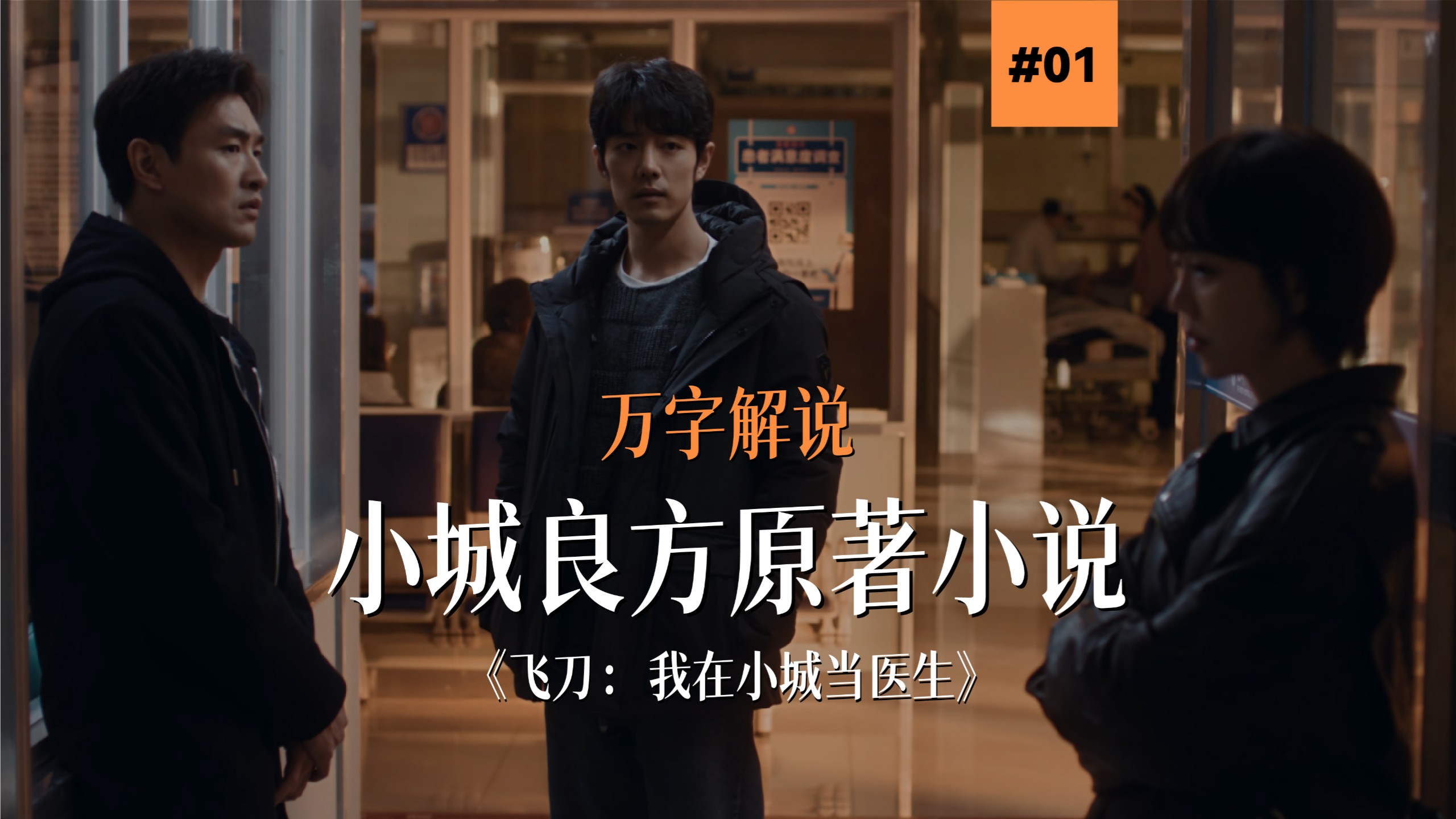
I just finished binge-watching the hit drama "Small Town Remedy" a couple of days ago, and it left quite an impression on me. I figured I might as well check out the original novel it was based on, and only then did I discover that the book is quite different from the TV series. So I thought, why not tell everyone the story from the novel? Maybe some of you are interested in it, just like I was.
The story takes place in a city in eastern Liaoning called Fushun, about 40-plus kilometers from Shenyang—in the TV series it's called Fengcheng, and the filming locations were probably Jinzhou and Huludao.
Liu Zhengliang, a neurosurgeon at Peking Union Medical College Hospital, is heading back to his hometown of Fushun over the weekend to perform a difficult surgery. Why would a Beijing doctor come back to Fushun to operate? To put it plainly, it's to earn some extra money.
Liu Zhengliang didn't come from a wealthy family. When he first started college, he happened to catch the wave of massive layoffs: the carbon plant, the chemical plant, the roofing felt factory, the machinery plant, the forklift factory, the steel plant—every single factory was cutting staff, and Liu Zhengliang's parents were no exception. Through all these ups and downs, he finally managed to finish his doctorate.
In his 30s, his personal life still hadn't worked out. In Beijing, he was dating a girlfriend who taught at an elementary school in Haidian, and she was also in her 30s—the two of them needed to give a straight answer about whether they were actually going to get married. Liu Zhengliang wanted to get married too, but getting married meant buying an apartment in Beijing, right? The girlfriend said: easy—each family contributes one million yuan, plus a loan of 1.5 million, and we buy a two-bedroom place in one go.
At this point, Liu Zhengliang's salary was only 11,000 yuan a month, and the girlfriend earned 8,500 a month. Even if Liu Zhengliang sold his grandfather's old house back home, he'd get at most a bit over 200,000 yuan—and even then, he might not find a buyer.
Under these circumstances, Liu Zhengliang's old classmate Chen Junnan offered him a way to make money: come back to Fushun to perform surgeries, charging 5,000 to 10,000 yuan per operation. Do two or three surgeries a weekend, and in about a year you could save up around a million yuan.
Now, Fushun has its own hospitals, and not far away there's the Shenyang Medical University hospital, Shengjing Hospital, and the Army General Hospital—all nationally renowned. So why would anyone need to bring in a doctor from Beijing to operate in Fushun?
Actually, Chen Junnan had quite a business mind. He noticed that some patients' families had a bit of money but didn't have the connections to get an appointment at the best hospitals—you could invite me for drinks in Fushun, but at a major hospital, you might not even get a corridor bed.
That's when he would reveal that he had some resources at hand: a locally born medical PhD is rare, someone who practices at the country's best hospital with credentials available for inspection anytime. If you agree, let's move quickly to negotiate.
This trip Liu Zhengliang made back to Fushun was a rush job Chen Junnan squeezed in at the last minute, offering 30,000 yuan—that's equivalent to half a square meter of a suburban Beijing apartment, so Liu Zhengliang had no reason to refuse.
The surgery this time was for an aneurysm. Was it difficult? Yes. Was it dangerous? Dangerous. If it weren't difficult, wouldn't charging 30,000 yuan be a rip-off? But Liu Zhengliang also made things clear upfront: even if the surgery went smoothly, there was still a chance of re-bleeding within ten days to half a month; if it bled again, it would be very hard to save the patient.
The patient's grandson hesitated a bit after hearing this, repeatedly asking: if we spend the money and the patient isn't saved, what happens to the surgery fee then? Both Chen Junnan and Liu Zhengliang were getting a little impatient—the reasoning had been explained, the risks assessed, and continuing to ask like this was getting a bit rude. So Chen Junnan said: there's nothing in this world with absolute certainty.
If you feel it's not reliable, then don't ask Dr. Liu to do the surgery—just use our own Fushun doctors, and he'll go back to work. That way you can feel at ease, and just do your best for the old man.
"Of all virtues, filial piety comes first—judge it by the heart, not by the deed; judge it by deeds, and no poor family would have a filial son."
Hearing the doctor put it that way, the patient's son quickly smoothed things over and signed the informed consent form.
After tremendous effort, Liu Zhengliang finally completed the surgery successfully. It sounds simple the way I tell it, but this operation was extremely difficult. How difficult?
Here's an analogy: it's like Liu Zhengliang's grandfather, in his 60s, riding a bicycle through the Fushun flower-and-bird market, with Liu Zhengliang on the front crossbar, reaching back with one hand to steady a bathtub he'd just bought, a birdcage strapped on the back, dodging the fakes at the antique stalls under his wheels—swerving left and right, but never once letting his feet touch the ground.
That's how Liu Zhengliang held on for over two hours, finally earning the 30,000 yuan the patient's son gave him.
After the patient's son and grandson had walked away, Liu Zhengliang was about to go find Chen Junnan when a young woman suddenly called out to stop him. This woman was Ai Chen—she and Liu Zhengliang had already exchanged greetings before he entered the operating room. Ai Chen was beautiful, with short hair, slender eyebrows, and a small cherry mouth.
She ran a restaurant, but not an ordinary one: if you went there to treat friends to a casual meal, you'd probably get beaten up—because it was a restaurant specializing in funerals, named after a crosstalk piece: "The Funeral Gathering." Her father was Ai San, the owner of Fushun's most famous one-stop funeral service business.
In Northeast China, the big temperature difference between indoors and outdoors in winter puts a heavy strain on elderly people's cardiovascular and cerebrovascular systems, so this season is the peak season for Ai Chen's family business. They were short-handed these days, so Ai Chen came over to help out. She stopped Liu Zhengliang to tell him: when the patient's son gave you the money just now, the patient's grandson filmed the whole thing—you'd better watch your back.
Liu Zhengliang was a ten out of ten in medical skill, but his score in social experience was really not high at all—he barely took it seriously. The two of them took the chance to chat for a bit—and you know what, Ai Chen actually left a pretty good impression on Liu Zhengliang. But good impression aside, when he remembered what he'd come here for—wasn't it just to make money and get married?—his impression of this girl ended right there.
And so, Liu Zhengliang went back to Beijing and returned to work.
Unexpectedly, a month later, Chen Junnan suddenly called: the aneurysm patient had fallen into a coma and been readmitted to the hospital. The family's emotions were extremely unstable, and it felt like something terrible was about to happen. Chen Junnan tried everything to save the patient, using every method available, but nothing worked—in the end, during chest compressions, he even broke one of the patient's ribs, and the patient still couldn't be saved.
The family exploded. The next day, a mourning hall was set up right in the neurosurgery lobby, and the funeral procession filled the entire floor. Chen Junnan was terrified, and the matter escalated all the way to the hospital director.
The director handled it strictly by the book: sue us if you want—if a forensic institution determines the patient's death was caused by hospital malpractice, take the assessment results and sue, and we'll pay whatever compensation is due. As for the charge of illegal medical practice, that was a contract your family made privately with the operating surgeon—if there's a problem, go take it up with the surgeon.
As for Chen Junnan, the hospital will certainly deal with him.
When the family failed to get the outcome they wanted from the hospital, the patient's family went to consult a lawyer. The lawyer said that even if they won a lawsuit in this situation, the hospital would only pay one or two tens of thousands in compensation, but the legal fees alone would run two or three tens of thousands. The family figured it wasn't worth it, so they simply bought a train ticket and headed to Beijing to find Liu Zhengliang.
Meanwhile, Chen Junnan had also been ordered by the hospital to resign. But unlike Liu Zhengliang, he wasn't short of money for a house, and his father was deputy director of the local health bureau. His medical license hadn't been revoked either, so after resting at home for a while, he could easily find work at another hospital.
The two patient families made their way to Beijing, demanding not only that Liu Zhengliang refund the surgery fee but also pay 500,000 yuan for emotional distress. Liu Zhengliang naively believed that refunding the 30,000 yuan surgery fee would make them go away. Unexpectedly, even though the fee was refunded, the two families kept making a scene at the hospital for six straight days, and finally the matter trended on social media.
The story finally reached the ears of the department director, Wang Hao. Director Wang was one of the most famous doctors in the country, a top figure in the field, who had been receiving a State Council allowance in his forties—an idol Liu Zhengliang deeply admired from the bottom of his heart. Director Wang was stern and rarely smiled, never gave interviews, and disliked doctors who strayed from their proper work.
Someone who held himself to such high standards naturally demanded no less of others—he had no tolerance for flaws. In the end, however, he didn't fire Liu Zhengliang outright; instead, he had him resign voluntarily, which allowed Liu Zhengliang to keep his medical license. That was the greatest dignity he could offer this student.
Though he felt reluctant in his heart, he absolutely could not let this precedent stand. There was nothing more to say.
And so Liu Zhengliang lost his job at Peking Union Medical College Hospital. The two patient families, who had pursued the matter relentlessly, didn't get a single yuan more.
Leaving the hospital, Liu Zhengliang felt utterly despondent; it seemed he could no longer stay in Beijing. He asked his girlfriend out and told her what had happened, but she showed no willingness to face it together with him—instead, she seemed unusually polite. She said: marriage is about finding a suitable person to build a suitable family with, just like a joint-stock company—you find a suitable partner.
Liu Zhengliang understood that this was her way of giving him some dignity: polite when they met, courteous when they parted, breaking up amicably so everyone could save face.
He then stayed in Beijing for another month or so, struggling over how to tell his family about it—after all, his future had once looked so promising, and now he had nothing left. How could he face telling them? Then one day, out of the blue, his grandfather called and said: "Stop pretending in Beijing. The family already knows everything. If you really can't make it there, come home tomorrow—we'll make dumplings for you."
As for home—it really is a strange place. You work hard and grind away for a decade or two, determined to leave it behind and make your mark in the world, feeling invincible and capable of anything. But one day, when you can no longer stand on your own, the very place you once tried so hard to escape becomes the remedy that heals your pain.
Liu Zhengliang's grandfather had come to the Northeast from Jiangsu during the great migration to Manchuria. When he first arrived, he couldn't find work and could only make a living trading medicinal herbs from the Changbai Mountains to Shenyang, running through the mountains in the middle of the night with wolves on his heels.
In those days, only the bold dared to venture to the Northeast: if you were tough, everyone respected you; if you showed weakness, anyone who saw you would bully you. When you met a mountain, you leveled it; when you met water, you waded through. What else could you do?
But for Liu Zhengliang's generation, the education they received from childhood was: study hard, and once you get out, don't come back. So his grandfather's philosophy of "keep an open heart and walk boldly forward" seemed to give Liu Zhengliang a glimmer of hope.
Although Chen Junnan had been dismissed by the hospital, his family had plenty of connections. A month later, both Liu Zhengliang and Chen Junnan took positions in the emergency department of Fushun Second Hospital—the real-life model for the Xiaoximen Hospital in the TV drama. This was the hospital where Liu Zhengliang's father was born, and also where Liu Zhengliang himself was born.
When news came that Liu Zhengliang had joined Fushun Second Hospital, his grandfather was the happiest of all: only a five-minute walk to and from work; his grandson had gotten his education and seen the world, and now he could stay by his side—maybe he'd even be there to see him off at the end. Life, one could say, was truly complete.
What Liu Zhengliang never expected was that the most valuable period of his life would be spent here.
When Liu Zhengliang reported to Fushun Second Hospital, it was Director Long who came to meet him in person. As for Liu Zhengliang's "moonlighting scalpel" surgeries—a serious offense at PUMC Hospital—to Director Long, it was no big deal at all.
Director Long's management style was called "turning a blind eye": Fushun's economy was poor and doctors' salaries weren't high, but every department still needed doctors who could hold their own. Which doctor wasn't trained on patients' bodies, even their lives? Who could put down their textbooks, pick up a scalpel, and immediately cure every patient they saw?
A good doctor, painstakingly built up over years of time and countless patients—someone who had studied for more than twenty years and endured more than a decade of hardship—once mature, wanted to go to Shenyang, Beijing, or the South to earn more money. Could you really stop them?
So Director Long didn't fuss over minor details; keeping good doctors around meant, on a small scale, that he could serve as director with peace of mind, and on a larger scale, that poor people nearby had somewhere to go for medical care—a truly meritorious deed. But Director Long wasn't without principles or bottom lines: making ordinary people spend money unnecessarily for nothing—that was unacceptable.
If an illness that could be cured for thirty yuan was treated with three hundred yuan worth of medicine, and the pharmaceutical company kicked back a hundred yuan in commission—anyone who dared to do that had gone completely down the wrong path, and the hospital would not keep them under any circumstances.
The emergency department was full of young people. Besides Chen Junnan, there was a young woman named Che Mingming—a girl with a razor-sharp tongue who could talk anyone into a corner. Though quite good-looking, no one around her ever caught her eye, and she remained single to this day.
Liu Zhengliang's first patient in the emergency department was a driver of a "xiao liangkuai." What's a xiao liangkuai? It's a three-wheeled vehicle, commonly known as a "sanbengzi"—Fushun people call it a xiao liangkuai, or "little cool one," because in summer, sitting in one with the breeze blowing past feels wonderfully cool. In winter, the xiao liangkuai takes on a different form: a chimney sticks out from the vehicle, burning coal for heat inside while burning fuel to carry passengers outside.
That day, two xiao liangkuai drivers were having lunch together. One of them had brought zongzi his wife had made, and the other, joking around, grabbed one to eat. While laughing and eating at the same time, he got a zongzi stuck in his throat.
Fortunately, they weren't far from Fushun Second Hospital, so they rushed him over. The Heimlich maneuver didn't work, and intubation risked pushing the zongzi even further down—if they couldn't get it out, they'd have to cut into his windpipe. Liu Zhengliang searched for a long time, but there was nothing suitable in the emergency department.
Finally, in a flash of inspiration, he used hemostatic forceps to pull the zongzi out, and the man was saved.
But before the zongzi patient had even left, an ambulance brought in an even more serious case: a 15-year-old girl who had been hit and thrown into the air by a large truck on her way home from school. Her blood pressure was only 70/55, and she had slipped into a deep coma. Seeing the girl's condition, Liu Zhengliang's heart sank—so young, such a terrible pity.
They rushed to provide emergency treatment and sent her for a CT scan. When the CT results came out, it was alarming: brain herniation. As for what brain herniation is, we're not medical experts and don't dare to speak carelessly—everyone can look it up themselves.
In short, the situation was extremely critical. The girl's brain had been smashed beyond recognition, like tofu turned into tofu dregs. Without surgery, there would be no hope at all; even with surgery, she could still end up in a vegetative state.
The surgery and post-operative treatment together would cost roughly two to three hundred thousand yuan.
While everyone was still hesitating, the girl's father said: "We have to do the surgery. Our family isn't short of money." Although he said they weren't short of money, how could the doctors not see through it? If they weren't short of money, would the child be attending such a shabby school? Would they be living in such a run-down workers' community? But the doctors couldn't say any of this.
Seeing Liu Zhengliang hesitate for a few seconds, the girl's father dropped to his knees with a thud, saying: "Please, doctor, save my daughter. Even if you can't save her, our family is honest people—we will never blame you or demand compensation." Liu Zhengliang nodded and was just about to agree when Chen Junnan immediately cut in, telling them to hurry up and sign the forms and pay the surgery fees.
The girl's father left the hospital to borrow money, and after the girl's mother signed the forms, Liu Zhengliang prepared to begin the surgery.
So, can this little girl be saved? What other challenges will Liu Zhengliang face? We'll continue the story next time.
If you found this video interesting, please don't forget to follow and give it a like—it means so much to a new content creator. Thank you so much. I'll get right to recording the next video, and we'll pick up where we left off next time.